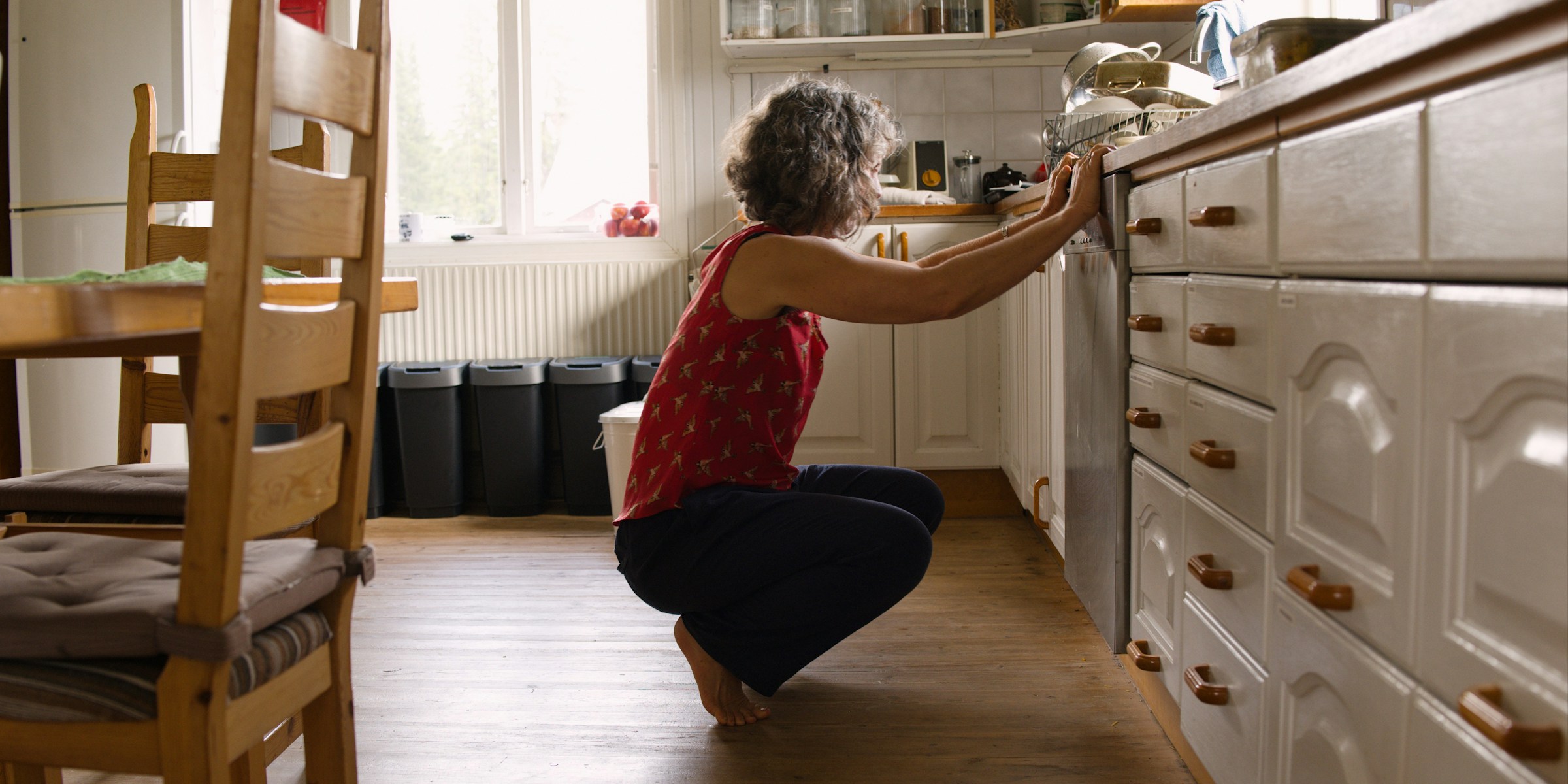
Only twenty-six percent of American adults meet both aerobic and muscle-strengthening guidelines. For older adults, that number drops to fifteen percent. Falls kill nearly seven hundred thousand people globally each year, the second leading cause of unintentional injury death worldwide. Thirty to forty percent of community-dwelling adults over sixty-five fall at least once every year. Most of those falls happen inside the house, on familiar floors, with no warning.
Strength you can actually use is not a gym metric. It’s the difference between getting up from the floor without help and asking someone to pull you up. Between carrying a half-bucket of compost three flights of stairs and leaving it at the bottom. Between losing your balance on a wet kitchen tile and catching yourself before your hip does the talking.
A simple measurement predicts all of this: grip strength. The PURE study involved one hundred and thirty-nine thousand, six hundred and ninety-one adults across seventeen countries, published in The Lancet in 2015, and found that every five-kilogram drop in grip strength increased all-cause mortality risk by sixteen percent. Cardiovascular mortality went up seventeen percent. The authors called grip strength “a simple, inexpensive risk-stratifying method.” A UK Biobank analysis of half a million people reached the same conclusion two years later. Grip strength is not destiny. But it is a marker.
There are five movements that keep that marker high. They cost nothing to learn, require almost no equipment, and produce measurable results in less than twelve weeks.
The Five Movements Mapped to Daily Life
Every movement in this list corresponds to an activity you will encounter in a normal week. The science behind them comes from meta-analyses and randomized controlled trials published in the last eighteen months. The pattern is consistent: practice the actual task, not an abstract exercise version of it.
1. The Sit-to-Stand (Chair Stand)
What it trains: Quadriceps, glutes, balance, coordination. What it saves you from: Not being able to get off the floor, out of a low chair, or off a toilet without using your arms.
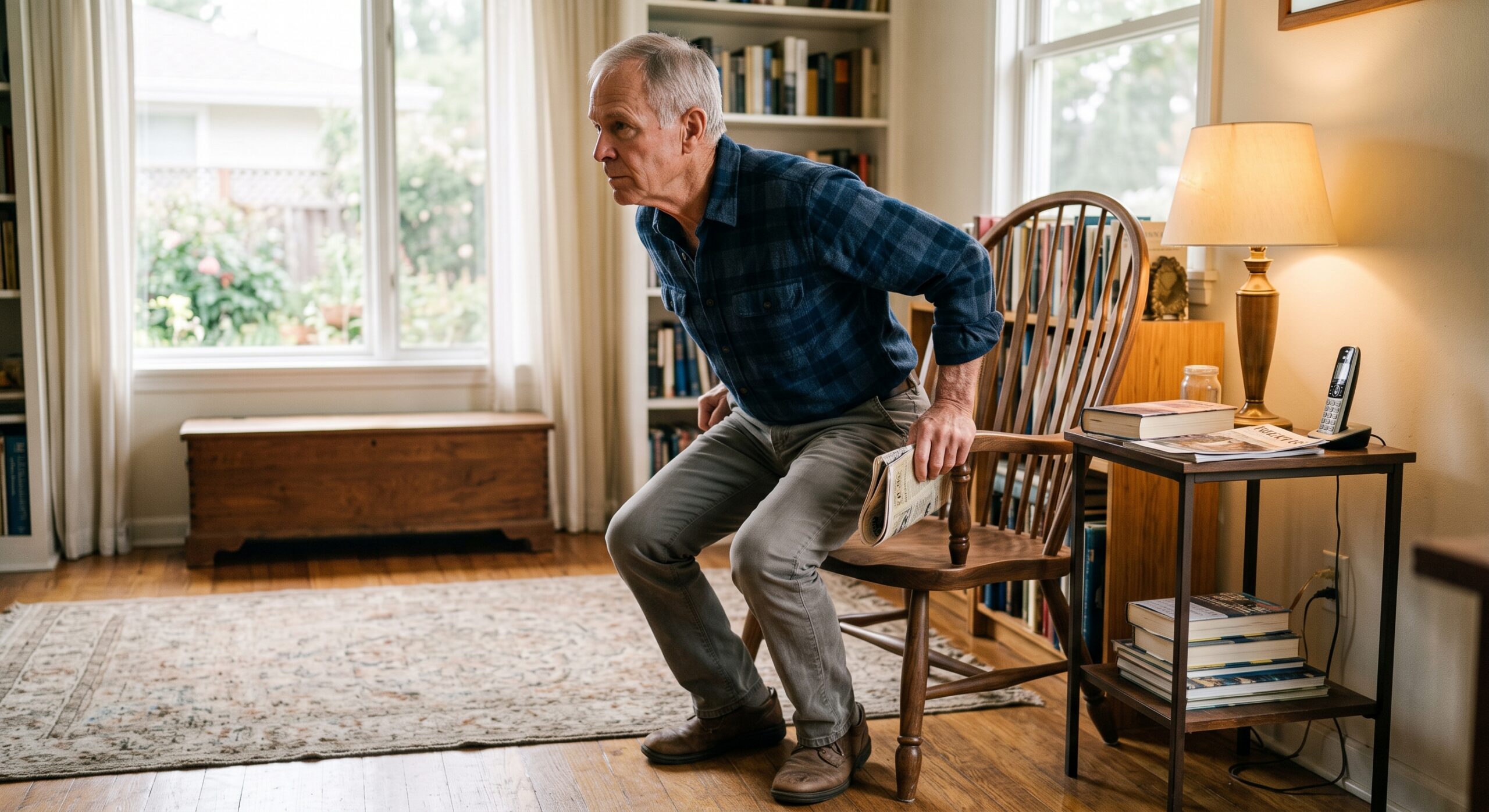
How to do it: Start seated on a sturdy chair with feet flat on the floor, hip-width apart. Lean forward slightly, drive through your heels, and rise to standing without using your arms for support. Lower yourself back down slowly. Four seconds on the way down is more valuable than exploding up. If you must grab the armrests, start there and work toward letting go of one hand, then neither.
The evidence: The FAST-2 trial (PLOS One, 2025, n=97, adults over sixty-five with walking difficulty) tested a program delivering about four minutes per day of lower-body functional work. Twelve weeks produced a four-chair-stand improvement and a twenty-three-second reduction in the five-times-sit-to-stand test by a clinically meaningful margin versus control. Eighty-one percent maintained daily adherence because the dose was small enough to stick. No serious adverse events were recorded.
This is the movement most people already do, hundreds of times a day. Training it deliberately means when your legs give out from fatigue or pain, you still come up.
2. The Hinge Pattern (Lifting from Low)
What it trains: Hip extensors (glutes and hamstrings), spinal stability, load positioning. What it saves you from: Herniated discs from bending wrong, pulled hamstrings from picking things up carelessly.
How to do it: Stand with feet shoulder-width apart. To lift something from the ground, push your hips backward first so your torso angles forward while your knees bend slightly. Keep the object close to your body throughout. Drive through your heels to return to standing, squeeze your glutes at the top. The hinge happens at the hips, not the spine. If you feel it in your lower back instead of your posterior chain, reset and reduce the weight.
The evidence: Resistance training in older adults produces gains in rate of force development, defined as how quickly you can generate power, at rates that challenge the old assumption that strength training only builds slow, maximal strength. A 2025 narrative review (PMC) covering maximal strength training in frail and clinical populations confirmed that loads of eighty to eighty-five percent of one-rep maximum improve not just peak force but speed of contraction. For everyday use, this matters more than raw numbers: falling objects and unexpected loads demand rapid response, not maximum effort over ten seconds.
Practice with empty hands first. Once you can hinge cleanly with good form, add weight like a filled backpack, a milk jug, or a sandbag. Progress slowly.
3. The Push (Press)
What it trains: Chest, shoulders, triceps, core stabilization. What it saves you from: Being unable to push yourself up from a fall, open stuck doors, or move furniture during an emergency.
How to do it: Wall push-ups are the entry point. Stand about an arm’s length from a wall, place palms flat at chest height, keep body in a straight line from head to heels, and lower your chest toward the wall before pressing back. Progress to incline push-ups on a countertop, then to floor push-ups (knees or toes), then to a pike position with hips elevated, body forming an inverted V, for shoulder emphasis. Each variation increases the percentage of bodyweight you’re lifting.
For vertical pushing: press water jugs overhead until you can do ten clean reps with moderate weight. This trains the exact muscles needed to push something overhead or brace against a collapsing surface.
The evidence: Community-dwelling adults in their sixties who followed ACSM resistance-training guidelines matched untrained adults in their twenties on functional tests including the six-minute walk (ACSM’s Translational Journal, 2025). Push strength contributes directly to upper-body capacity measured in these studies; upper-body strength also correlates with independence in activities of daily living across all age groups.
4. The Pull (Row or Carry)
What it trains: Upper back, rear delts, biceps, grip strength, core anti-rotation. What it saves you from: Rounded posture from sitting too much, weak grip that makes everything harder, asymmetric strength from carrying bags one-sided.
How to do it: Try towel rows anchored under a door, resistance-band rows anchored at waist height, or inverted rows under a sturdy table. Focus on pulling your shoulder blades together before bending your elbows. You should feel this between your shoulder blades, not in your forearms alone.
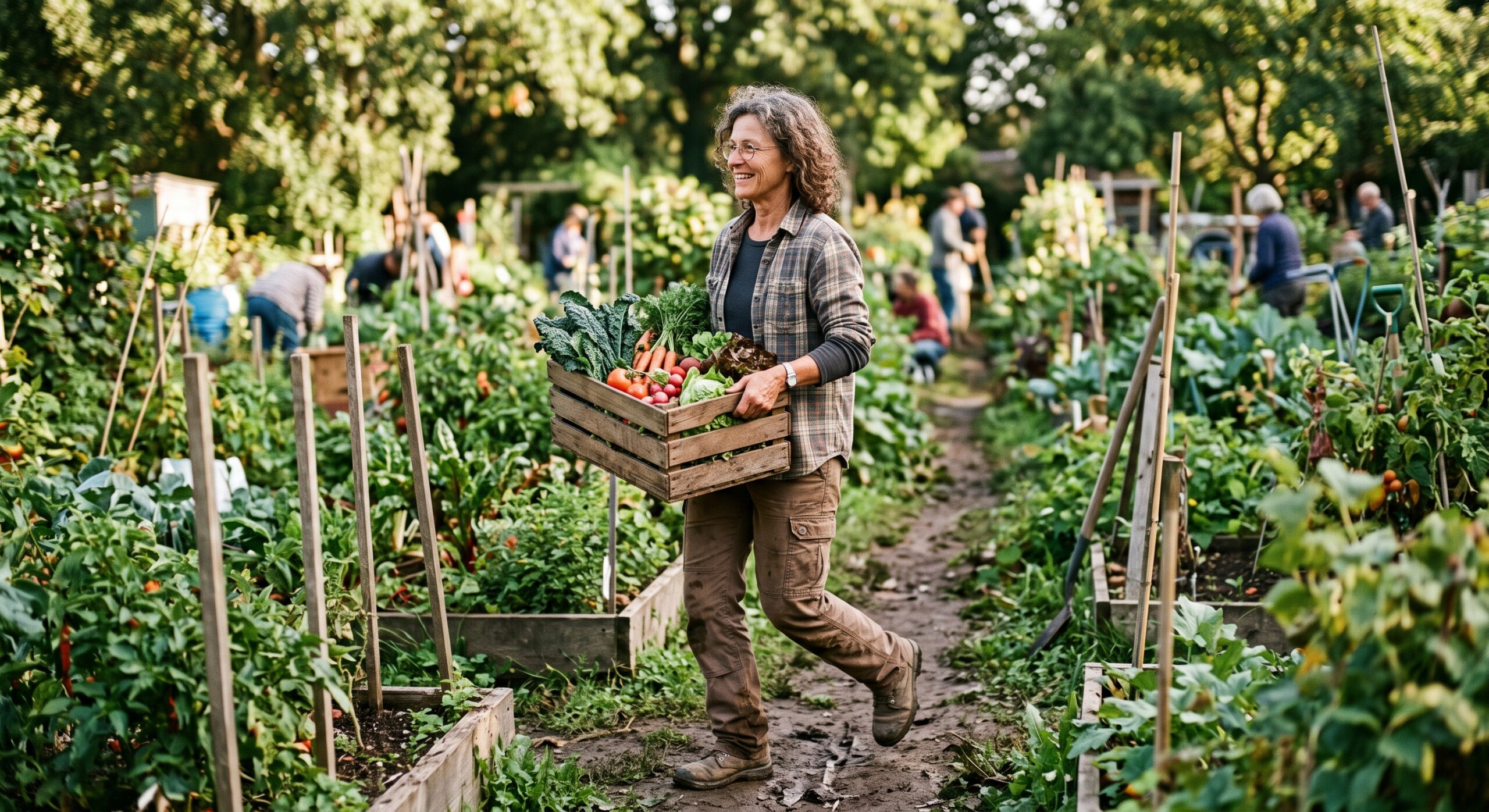
Farmer’s carries: Hold moderate weights in both hands (dumbbells, kettlebells, or grocery bags) and walk with deliberate, even steps for twenty to thirty meters. Keep shoulders down and back, spine neutral, gaze forward. This builds grip, traps, and stability simultaneously. Switch hands halfway through if using asymmetrical loads like grocery bags.
The evidence: The same FAST-2 trial that demonstrated chair-stand improvements also documented grip strength gains as a secondary outcome. More broadly, the PURE study established grip strength as a mortality predictor precisely because it reflects overall muscular capacity. Nobody gets strong grip strength in isolation. Pulling movements are the missing complement to pushing in most older adult routines, which tend to emphasize anterior-chain exercises and neglect the posterior upper body.
Do pulling movements twice per week. Do farmer’s carries once per week and note whether your grip fails before your legs do. That tells you where to focus next.
5. Single-Leg Stance (Balance Work)
What it trains: Ankle stabilizers, proprioception (your body’s sense of its position in space), vestibular integration, hip abductor strength. What it saves you from: Falls on uneven surfaces, stair missteps, sliding on wet floors.
How to do it: Stand on one leg, hold onto a wall or counter only if needed for safety. Begin with eyes open. When that feels easy, close your eyes. This removes visual reference and forces your ankle and hip stabilizers to work harder. Hold for thirty seconds per side. Progress by reducing hand contact (light fingertip touch, then no touch), by changing the surface (floor to towel on hardwood, then to a foam pad), and by adding head turns (look left, look right while maintaining balance).
The evidence: Functional Task Training, which includes single-leg balance tasks, produces a standardized mean difference of 0.85 on the Timed Up and Go test, a clinical measure of fall risk. A 2025 meta-analysis of forty-three articles and fifty-one studies covering two thousand seven hundred forty-three participants identified eight weeks minimum, thirty minutes per session, as the effective prescription for multicomponent exercise programs targeting fall-risk reduction. Mind-body approaches like Tai Chi performed comparably, but isolated single-leg practice achieves a fraction of that time commitment.
This is the movement most people skip because it doesn’t feel like “exercise.” It produces the most direct return on investment for fall prevention available.
The Minimum Effective Dose
You don’t need an hour at a gym. You don’t need equipment. You need consistency.
Twelve weeks of resistance training plus one weekly high-intensity interval session improved VO2 max by six percent, increased lean mass, improved inflammatory regulation, and lowered cholesterol across demographics, per a GeroScience study (2025, n=41, ages fifty-five to seventy). The training volume was modest. The key was duration: benefits were strongest above twelve weeks and with high adherence.
Adherence is where most programs fail. The FAST-2 trial reported eighty-one percent daily adherence because the intervention required roughly four minutes per day. A SilverSneakers data point cited within that paper shows fewer than thirty percent participation in supervised programs, even when they’re free and professionally designed. Short duration solves part of the problem; convenience solves the rest. Here’s what that looks like in practice:
Monday/Wednesday/Friday: five minutes. Three sets of ten sit-to-stands. Three sets of ten hinges (bodyweight or light load). Ten wall push-ups. Ten rows with a resistance band. Thirty seconds single-leg per side.
Tuesday/Saturday: twenty minutes of walking with purpose, alternating between stairs, hills, and brisk pace. One set of farmer’s carries.
Sunday: rest. Or stretch. Or both.
That’s forty-five minutes total. If you miss a day, you don’t make it up. You continue. Consistency beats intensity every time in the long game.
The meta-analysis of multicomponent exercise programs confirms the prescription: eight weeks minimum, thirty minutes per session if structured formally, or the distributed micro-doses described above. Strength-only programs help, but multicomponent (strength + balance + mobility) wins on balance outcomes. Add walking or light cardio for cardiovascular benefit. That’s it. No gadgets. No subscriptions. No equipment beyond what fits in a drawer.
Where Heavy Loads Fit In
The conventional advice for older adults has been: light weights, high repetitions, cautious progression. The research says otherwise. And this matters because it changes how aggressively you train once you’ve built a foundation.
A 2025 narrative review examined maximal strength training, defined as loads at eighty to eighty-five percent of one-rep maximum, in older adults including frail and clinical populations. Results: significant gains in maximal strength, rate of force development, and power. The researchers called for implementing this in clinical practice. That means the question is no longer “can older adults handle heavy loads?” but rather “how do we get them to do it safely?”
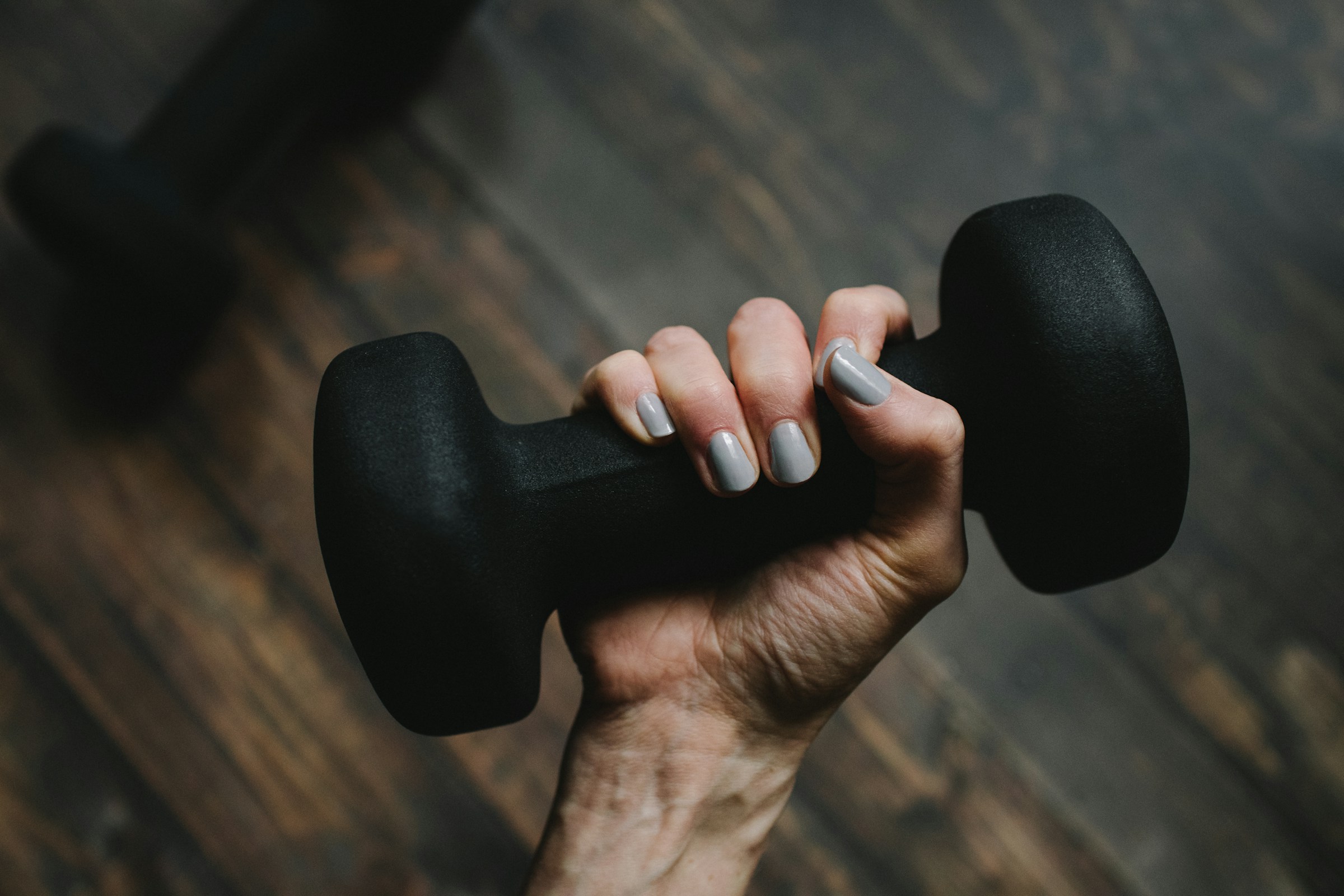
Heavy loads come second. First, you build the habit and the movement patterns. Once you can perform all five movements with clean form for three consecutive sessions, introduce progressive overload: increase weight or resistance by the smallest increment available. Two-and-a-half pound dumbbells exist for a reason. So do resistance bands rated in five-pound increments. Start heavier than necessary for ten reps; aim for failure at twelve or fifteen. Rest ninety to one hundred twenty seconds between sets. Track your numbers. Progress visible on paper reinforces the habit faster than any motivational framework.
The caveat: readers with osteoporosis, cardiac conditions, or recent surgery need clinician clearance before loading heavily. Progressive overload works, but it demands a baseline of joint integrity and cardiovascular fitness. If you’re unsure, start lighter, progress slower, and ask a professional who understands your specific history.
One clarification: “functional” is an umbrella term with no certifying body. Programs branded as functional fitness may share none of the scientific backing behind Functional Task Training. Anchor your expectations to the trials, not to marketing.
Your Self-Test Box
You don’t need a clinic to gauge where you stand. Here are three quick assessments you can run at home:
Thirty-second chair stand: Count how many times you can stand fully from a standard-height chair and sit back down in thirty seconds, using your arms only if absolutely necessary. Norm ranges: forty to forty-nine years: fourteen to eighteen reps depending on sex; fifty to fifty-nine: twelve to sixteen; sixty to sixty-nine: nine to thirteen; seventy-plus: six to eleven. Falling below the typical range for your age group suggests room for improvement, not pathology.
Single-leg stance (eyes closed): Time how long you can balance on one leg with eyes shut, stepping away counts as termination. Typical: nineteen to twenty-two seconds for ages fifty to sixty-four; sixteen to nineteen for sixty-five to sixty-nine; twelve to fifteen for seventy to seventy-four; and declines further with age. Under ten seconds at any age flags elevated fall risk.
Grip dynamometer: A handheld grip strength meter costs around twenty dollars online. Squeeze the handle, record the number, compare to population norms by age and sex. The PURE study used kilograms: a five-kilogram decline predicted higher mortality. A decline of ten kilograms or more from your own prior reading, measured over months or years, warrants attention regardless of absolute values.
These aren’t diagnoses. They’re signals. Low scores create urgency; decent scores create confidence. Either way, you know where you are.
Why This Matters
Self-reliance isn’t primarily a purchase. It’s a capacity. Every article on this site that touches food preservation, local computing, or energy resilience leads to the same observation: the skills and infrastructure you control matter more than the devices you own. Functional fitness belongs in that category because it sits at the intersection of capability and autonomy: strength that serves immediate, tangible needs rather than aesthetic ones.
The alternative to deliberate practice isn’t stagnation. It’s decline. Muscle mass decreases roughly one percent per year after fifty without intervention. Balance systems degrade. Grip fades. These aren’t cliff-edge events. They’re inches lost per month that compound into years of increasing dependency. The movements listed here interrupt that curve. They’re not glamorous. They don’t require special knowledge or expensive tools. But they work, and the trials published in 2025 leave less uncertainty than earlier research ever did.
Start today. Not Monday. Pick one movement and do ten reps today. and do ten reps. Tomorrow, add another. By the end of the week, you’ll have covered all five. By the end of twelve weeks, you’ll notice the difference when you pick something up off the floor, carry groceries, climb stairs, or navigate a wet surface.
The measurements don’t lie. Neither does the experience of knowing you can handle your own life.
Related reading

Build a Home Apothecary: 10 Herbal Preparations That Replace Over-the-Counter Staples
The pharmacy counter sells single-molecule isolation wrapped in fragile supply chains. Here is the evidence-based field guide to brewing, pressing, and infusing your own medicine …

The Evidence on Vitamin D: Why Indoor Life Leaves You Deficient (and What to Do About It)
About one in five American adults runs low on vitamin D, and the reason has almost nothing to do with diet or discipline. It is …

Ginger Bug Soda: The $0.10 Alternative to $5 Probiotic Drinks
The probiotic soda aisle is a $5 bottle of sugar water. The same fizzy, live-culture drink from your kitchen counter costs 15 cents — and …