
About one in five American adults runs low on vitamin D, and the reason has almost nothing to do with diet or discipline. It is geometry: where you live, how high the sun sits, and how much of your life happens behind glass. The good news is that this is one of the few health numbers you can measure and move entirely under your own roof. Here’s what the latest research says about why the gap exists, what it actually costs you, and the protocol that closes it.
Why Indoor Life Leaves You Deficient
Vitamin D is closer to a hormone than a vitamin: your skin makes it from ultraviolet B light, and almost nothing else in the body can substitute. That design worked fine for outdoor lives near the equator. It works poorly for a software engineer in Boston who eats lunch at her desk.
The numbers, with their thresholds attached, because the cutoffs matter:
– In the NHANES survey of 16,180 Americans (2011–2014), 5.0% were deficient by the strict Institute of Medicine cutoff (under 30 nmol/L, or 12 ng/mL) and another 18.3% sat in the inadequate band (30–49 nmol/L). Add those and roughly one in five adults had a low number.
– Using the looser 20 ng/mL line, the Endocrine Society’s 2024 guideline cites 24% of US adults below it, and 6% below 10 ng/mL. Different yardsticks, same story.
– Deficiency peaks not in the elderly but in adults aged 20 to 39, at 7.6%: the indoor-working cohort.
– By race, 17.5% of non-Hispanic Black Americans were deficient versus 2.1% of non-Hispanic white Americans. Skin pigmentation evolved under intense year-round equatorial UVB; a Minnesota winter is a different physics problem for darker skin, through no fault of anyone’s.
The mechanism is mostly unglamorous physics:
Latitude and season. Above roughly the 33rd parallel, winter UVB drops so sharply that skin synthesis essentially stops for months: Boston (42°N) gets nothing useful from November through February, and cities at Edmonton or Bergen latitude lose synthesis for about six months. UK cohorts show average 25(OH)D peaking around 30 ng/mL in September and bottoming near 14 ng/mL in February. The winter vitamin D gap is a planning problem, the same way frost dates are a planning problem for a garden.
Glass. Window glass absorbs essentially all UVB. The sun through your office or car window warms your arm and produces no vitamin D whatsoever.
Indoor work and shift work. A Singapore workplace cohort found office workers 2.16 times as likely to be deficient as control-room peers, with night-shift workers at 1.31 times. The mechanism, not the country, is the finding: indoor employment is the exposure variable.
Body composition and age. In a controlled UVB study, obese subjects raised their blood vitamin D about 57% less than lean subjects on identical exposure, thanks to dilution into fat stores. Aging skin synthesizes less at every dose of sun. Air pollution absorbs UVB too; Los Angeles and San Diego measurably underperform their latitudes on clear-sky days.
None of this is a character flaw. It is what happens when a species built for outdoor equatorial life moves into climate-controlled boxes at 42 degrees north.
What Being Low Actually Costs You
Here is where the evidence gets interesting, because it cuts against both the supplement industry and the shrug. The largest and best-run trials of the last decade are blunt: in adults who are already replete, vitamin D pills do almost nothing.
– Bones and falls. Severe deficiency (under 10–12 ng/mL) genuinely causes rickets in children and osteomalacia in adults; that part is settled, and correcting severe deficiency is not in question. But the 2018 Bolland meta-analysis of 81 trials (about 53,000 participants) found that supplementation, at any dose tested, does not prevent falls or fractures and does not meaningfully change bone density in adults who are not severely deficient.
– Cancer and heart disease. VITAL, the largest trial to date (25,871 US adults, 2,000 IU daily, median 5.3 years), found no reduction in invasive cancer or major cardiovascular events. There was a secondary signal for lower cancer mortality (hazard ratio 0.83), which is suggestive, not definitive. A 2019 JAMA Cardiology meta-analysis of 21 RCTs and 83,291 participants reached the same flat conclusion for cardiovascular endpoints.
– Autoimmune disease. The signal that survived: VITAL’s autoimmune analysis found incident autoimmune disease reduced by about 22% (HR 0.78, 95% CI 0.61–0.99), and the effect persisted two years after the trial ended. Modest, real, and worth knowing about.
– Respiratory infections. A 2017 individual-participant meta-analysis found about 12% lower acute respiratory infection risk overall, concentrated in deficient people. The 2025 Lancet update moved the overall estimate to OR 0.94 (0.88–1.00), no longer statistically significant across everyone. Read both together: any benefit lives in the people with low baseline status.
– Mood. VITAL-DEP (18,353 adults, five-plus years) found no reduction in depression incidence or recurrence. Low vitamin D correlates with depression; correcting it does not prevent it.
A Nature Reviews Endocrinology consensus drew the same line: supplementing replete adults shows no demonstrable benefit for cancer, cardiovascular disease, falls, or diabetes progression, while severe deficiency (under 30 nmol/L) should still be corrected. Fix the deficiency. Don’t chase miracles. A $12 monthly supplement is a reasonable tool; an $80 megadose stack sold on the weak claims is a tax on hope. Self-reliance includes not buying the hype, and the trial record above is the receipt.
The Fix: Measure It, Then Move It
Everything below assumes you’re a generally healthy adult making household decisions. Symptomatic patients are a different conversation, covered at the end.

Start with food, knowing its limits
Per the NIH Office of Dietary Supplements, the useful amounts are:
– Sockeye salmon, 3 oz: 570 IU
– Rainbow trout, 3 oz: 645 IU
– UV-exposed mushrooms, half a cup: 366 IU
– Fortified milk, 1 cup: 120 IU
– Egg, 1 large: 44 IU
The RDA is 600 IU daily for adults under 70 and 800 IU over 70, and it assumes minimal sun. Hitting that from food alone takes fish most days plus fortified staples; it is doable but it takes intent. The mushrooms point is underused: mushrooms exposed to UV (many commercial growers do this deliberately) carry real D2, and they are the only plant source that does.
Use the sun deliberately, where it exists
Roughly 10 to 30 minutes of midday sun on arms and legs, two or three times a week, produces substantial vitamin D in lighter skin; darker skin needs proportionally more. The protocol has three rules. First, glass does not count, ever. Second, north of about 37 degrees latitude, the winter sun is nearly useless from November through February, so plan around the gap rather than pretending it away. Third, never burn: dermatology’s consensus is that deliberate unprotected exposure carries a skin-cancer bill, which is a large part of why supplements exist in the first place. Tanning beds are not a loophole; they are the bill without the vitamin.
If you supplement, dose it like an adult
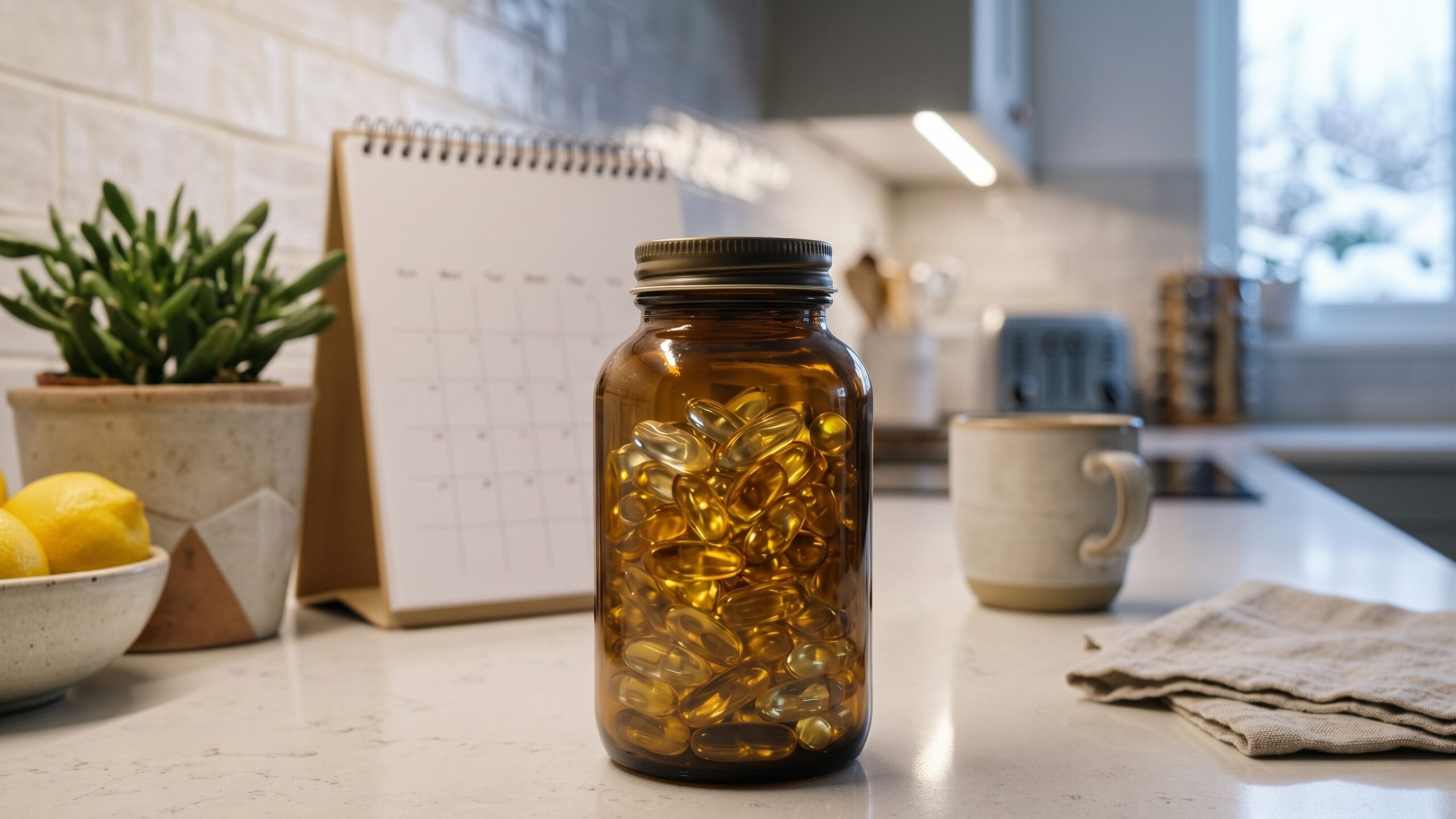
The tolerable upper limit is 4,000 IU per day from all sources, and that is a hard household rule, not a starting point. The RDA range (600–800 IU) covers most healthy adults. Toxicity (levels above 150 ng/mL) comes from supplement megadoses; it has never been documented from sun exposure. Doses above the upper limit belong to one situation: a documented deficiency being treated by a physician, sometimes short-term.
Know your number if you want certainty
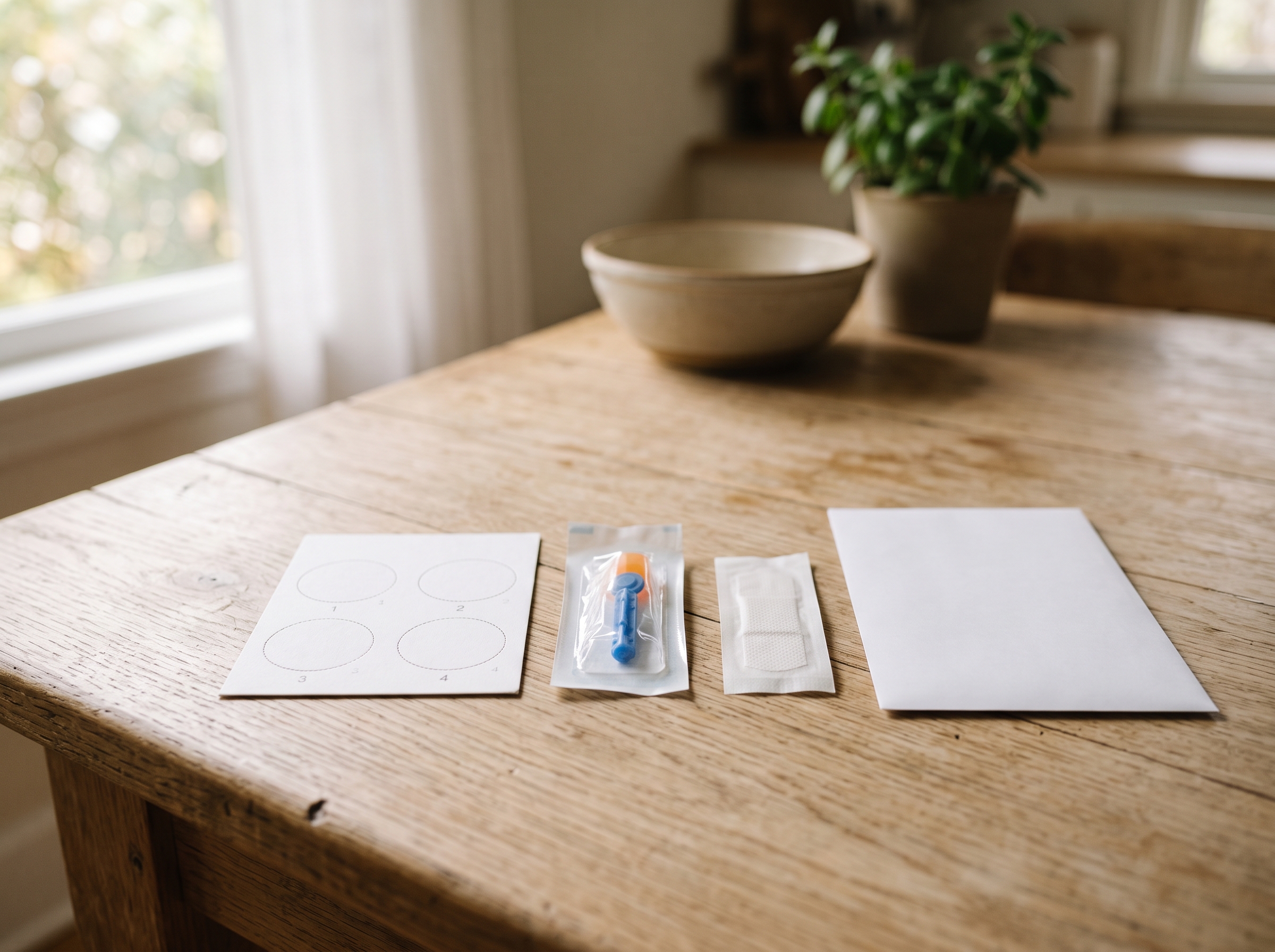
Home 25(OH)D finger-stick tests have made this cheap: Everlywell’s kit runs $49, myLAB Box $99, and both use CLIA-certified labs with online results. An uninsured clinic draw runs $80 to $200, so a home kit is roughly half the cash price of the traditional path. The same self-knowledge logic as a soil test or a water test applies: you are not diagnosing anything, you are checking a number so you can act on information instead of vibes.
On who should test, two expert bodies genuinely disagree, and you should know both positions. The USPSTF’s 2021 recommendation is an I-statement: for healthy, asymptomatic adults, the evidence is insufficient to recommend for or against screening, because treating a number in a well person has not shown benefit. The Endocrine Society’s 2024 guideline suggests routine testing is not needed for the general population either, while recommending empiric supplementation beyond the RDA for specific groups: adults over 75, pregnant patients, children and teens, and people with high-risk prediabetes. Both are guidelines for people without an established medical indication. A home result is a screening datapoint, not a diagnosis, and lab methods vary enough that borderline numbers deserve a confirmatory draw.
See a doctor when it stops being household-level
Bone pain, persistent muscle weakness, a fragility fracture, an osteoporosis workup, a history of celiac or Crohn’s disease or bariatric surgery, kidney or liver disease, pregnancy: these are where testing and therapeutic (sometimes above-the-limit) dosing are clinically indicated, and the guideline fences above do not apply to you.
Why This Matters
The winter vitamin D gap behaves like every other seasonal problem this site covers: you cannot change the latitude, but you can plan around it. Know your rough status once (a $49 test, or your risk profile), fix food first, use the sun where the season allows, keep any supplement at or under 4,000 IU, and spend your money on correction rather than megadose marketing. The evidence supports exactly one claim with confidence: people with low numbers benefit from raising them, and almost everything else the industry sells rides on top of that single fact. That is a fix you can run entirely under your own roof.
Further reading on the household-health thread: our cost-and-evidence breakdown of DIY kombucha and ginger bug soda, and the medical shelf of the offline library for when you want your references to survive an outage.
Related reading

Build a Home Apothecary: 10 Herbal Preparations That Replace Over-the-Counter Staples
The pharmacy counter sells single-molecule isolation wrapped in fragile supply chains. Here is the evidence-based field guide to brewing, pressing, and infusing your own medicine …

Functional Fitness for Self-Reliance: 5 Movements That Build Real-World Strength
Only twenty-six percent of American adults meet both aerobic and muscle-strengthening guidelines. For older adults, that number drops to fifteen percent. Falls kill nearly seven …

Ginger Bug Soda: The $0.10 Alternative to $5 Probiotic Drinks
The probiotic soda aisle is a $5 bottle of sugar water. The same fizzy, live-culture drink from your kitchen counter costs 15 cents — and …