Plug-in solar is the first clean-energy technology built for renters. The laws arrived before the products did.
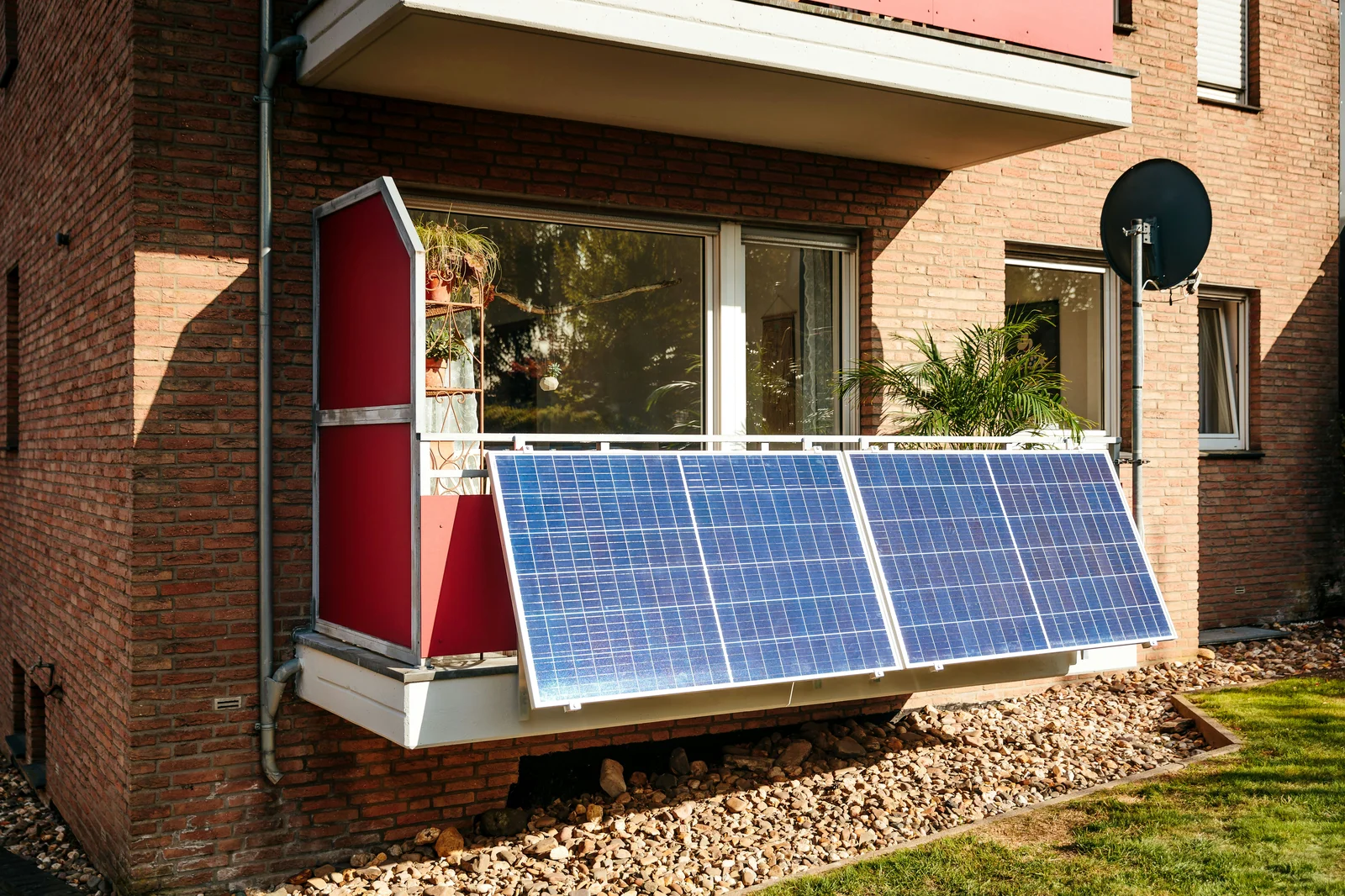
A dual-panel balcony solar array mounted on a residential balcony railing. The compact setup plugs directly into an outdoor outlet to offset daytime idle electrical loads. Photo: Bright Saver / PlugInSolarUSA
Utah legalized plug-in solar in March 2025 with a unanimous vote, and the dam broke. At least eight states have since signed balcony-solar bills into law, and trackers put the number as high as ten. More than thirty state legislatures debated them during the 2026 session.[1][3][7][13]
For the forty-four million American households that rent, this is the first solar technology that has ever been accessible to them.[2] Traditional rooftop solar demands homeownership, a five-figure capital outlay, long utility interconnection queues, and structural roof alterations. Balcony solar collapses all of that into two panels, a microinverter, and an outdoor wall outlet.
The catch is that the laws raced ahead of the hardware, the safety certifications, and the fine print. If you live in an enacted state and have a sunny patio, you can legally plug a generation device into your wall today.
What you can actually buy, what it powers, and what it costs to do safely are different matters entirely.
The Appliance Loophole
Every state bill passing across the country relies on a single legal maneuver: reclassifying small-scale solar as a household appliance rather than a power plant.[2][5]
| Traditional Rooftop Solar | Plug-In Balcony Solar |
|---|---|
| 5 kW – 10 kW system | 400W – 1,200W system |
| 5,000 – 5,000 cost | 00 – ,000 cost |
| Utility interconnection study | Exempt / zero-notification |
| Licensed electrician permit | Plugs into standard outlet* |
| Rooftop structural mount | Balcony railing / patio stand |
| Homeowners only | Renters & homeowners |
For decades, the moment a solar panel generated a single watt of alternating current, utilities treated it as a grid-tied generation facility. That triggered engineering reviews, formal interconnection agreements, specialized utility meters, and municipal building permits. The process took months and added thousands of dollars in administrative overhead.
The state legislation sweeping the country carves out an explicit boundary. If a system stays below a statutory power ceiling, typically 1,200 watts, it bypasses the entire utility interconnection apparatus.[2][12]
| State | Bill | Enacted | Power Cap | Key Statutory Provisions |
|---|---|---|---|---|
| Utah | H.B. 340 | March 2025 | 1,200W | First in nation; passed unanimously; zero utility approval or interconnection agreement required; requires NRTL certification.[2][5] |
| Virginia | H.B. 395 | April 2026 | 1,200W | Effective July 1, 2026; landlords with 4+ rental units cannot ban balcony solar; defers technical standards to a state work group.[5][7][8] |
| Maine | L.D. 1730 | April 2026 | 420W DIY | First law naming UL 3700; DIY installs capped at 420W; above 420W requires licensed electrician + 30-day utility notice.[4][8] |
| Colorado | H.B. 26-1007 | May 2026 | 1,920W | National high-water mark for power; blocks HOA bans; explicitly prohibits multiple plug-in units on a single circuit.[3][5] |
| Maryland | H.B. 1532 | May 2026 | 391W exempt | Systems under 391W exempt from UL certification and building-code alteration requirements.[3][4] |
The momentum is bipartisan, but state policies remain divided. In California, Senate Bill 868 cleared the Senate 35–1 and sailed through the Utilities & Energy Committee 12–0 on its way to Appropriations.[5][8] New York’s SUNNY Act and Connecticut’s H.B. 5340 moved through both legislative chambers this summer.[1][3]
Yet bills died in eleven states this year, including Washington, New Jersey, Pennsylvania, and Georgia. Opposition from utility trade groups and electrical unions consistently cited fire safety, islanding, and unregulated backfeeding onto local transformers.[3]

What 1,200 Watts Actually Runs
Marketing claims for balcony solar tend to promise energy independence. The physics tell a more disciplined story.
A 1,200-watt balcony kit with dual panels does not power a central air conditioner, an electric oven, or a level-two EV charger. What it powers is your apartment’s baseline daytime idle load.
| Appliance Baseline Load | What an 800W–1,200W Array Covers |
|---|---|
| Refrigerator compressor (150W–400W) | ✓ Fully covered during daylight runs |
| Wi-Fi router & modem (15W–30W) | ✓ Fully covered continuously |
| Home lab / mini PC server (35W–65W) | ✓ Fully covered continuously |
| Laptop & external monitors (90W–180W) | ✓ Fully covered during work hours |
| Smart TV & streaming box (80W–150W) | ✓ Fully covered during day use |
| Central A/C (3,000W–5,000W) | ✗ Grid supplies remainder |
| Electric dryer (2,000W–4,000W) | ✗ Grid supplies remainder |
A standard refrigerator compressor draws between 150 and 400 watts when running. A fiber modem, Wi-Fi router, and a home server idling a few Docker containers consume roughly 80 watts combined. A work-from-home desk setup with two monitors draws 150 watts.
During peak midday sun, an 800-watt to 1,200-watt balcony array absorbs those persistent loads entirely. Your electric meter slows down or stalls while the sun is overhead.
The German precedent gives us hard, long-term empirical data on what that yields in practice. In Berlin, a typical 600-watt balcony system costing roughly $530 produces approximately 550 to 600 kilowatt-hours annually.[10][11] At European retail electricity rates, that saves its owner roughly $100 per year, delivering a payback period of around five years.[11]
In the United States, retail electricity prices average around 16 to 18 cents per kilowatt-hour nationally, though regions like California and the Northeast sit above 30 cents. An 800-watt kit in a sunny climate offseting 700 kilowatt-hours per year yields between $110 and $220 in annual savings.
That is meaningful utility relief for a renter, but it is not whole-home self-sufficiency.
The Shopping List (Such As It Is)
If you decide to buy a kit in the United States today, the market looks very different from Europe.
In Germany, balcony solar kits sit on shelves at Aldi, Lidl, and Ikea for under €400.[1][10] Major consumer electronics manufacturers like Anker and Jackery sell all-in-one balcony systems with dedicated stackable lithium-iron-phosphate storage across the European Union. Anker launched its Solix Solarbank 2 E5000 Pro in Europe this June for €1,999, but has announced no US release date.[4]
American buyers choose from a smaller, domestic vendor roster:
| Kit | Price | System Output & Storage | Notes |
|---|---|---|---|
| BigBlue POWAFREE H1 | $699.99 sale ($1,399 MSRP) | 800W output / 2,560Wh LFP battery | Includes integrated battery storage; portable form-factor panels.[4] |
| US Solar Supplier Kit | $969 sale ($1,188 MSRP) | 810W grid-tied array | Grid-tied microinverter setup; no battery storage included.[4] |
| EcoFlow STREAM Ultra | $1,199 early-bird ($1,899 MSRP) | 800W output / modular battery | 10-year warranty, 6,000 cycles to 70%; launched initially in Utah.[4] |
| CraftStrom Balcony Kit | $2,031 | 800W output / zero-export controller | Specialized hardware designed for zero grid export.[4] |
Advocacy groups like Bright Saver, which also sells residential kits, advertise payback windows of three to five years based on peak electricity rates.[7] For most US households, a conservative payback horizon is six to nine years once hardware shipping and mounting brackets are factored in.
The Part That Actually Matters: Certification
Here is where the engineering reality collides with legislative enthusiasm.
Rooftop solar safely isolates itself during a blackout using specialized automatic transfer switches. When a consumer plugs a solar panel directly into a wall outlet, that outlet becomes a live power source. If grid power fails and utility line workers repair a downstream transformer, power from an unregulated balcony inverter could backfeed onto the street wiring, creating a lethal hazard.
To solve this, Underwriters Laboratories published UL 3700 (“Outline of Investigation for Interactive Plug-In Photovoltaic Equipment and Systems”) in late December 2025, opening formal lab testing in January 2026.[5][6]
UL 3700 Mandated Safety Protections:
- Rapid Plug De-energization: Pins must go electrically dead in <1 second upon unplugging.
- Anti-Islanding: Inverter disconnects generation immediately if grid voltage drops.
- Ground-Fault Detection: Auto-shuts off if current leaks to chassis or moisture ingress occurs.
- Overload & Reverse-Current Protection: Prevents wire overheating on shared branch circuits.
The engineering standard is rigorous. The problem is timing.
As of August 2026, only one individual component has achieved UL 3700 certification: the Hoymiles HiFlow Pro microinverter, certified in July 2026.[9][13] Not a single complete consumer kit has achieved full UL 3700 system-level certification.[13]
If you assemble a kit today, your baseline buyer’s rule is non-negotiable: require a UL 1741 SB-certified microinverter at absolute minimum.[5][6] UL 1741 SB is the established standard governing utility-interactive grid inverters with anti-islanding protection. Full UL 3700 packaged kits will begin reaching the US market in late 2026 and early 2027.
The Honest Trade
Here is the honest trade at the center of plug-in solar, and I’d rather state it plainly than sell you a fantasy.
The promise of balcony solar is “plug it in and walk away.” The reality of residential building wiring is that standard branch circuits were never engineered to carry power in both directions simultaneously.
When current flows from the utility service panel into a bedroom circuit, a fifteen-amp circuit breaker protects that circuit’s wires from overheating. If you plug an 800-watt solar panel into a wall outlet at the far end of that circuit while running an iron or a space heater on the same line, the solar inverter feeds power directly into the appliance. The upstream breaker never sees that extra current.
Standard Branch Circuit Backfeeding Risk
========================================

[Breaker Panel: 15A] ───────────────────────────────────────────────┐
         │                                                          │
         │  Draws 14A (Breaker reads 10A — DOES NOT TRIP!)          │
         ▼                                                          │
   [Space Heater: 14A] ◄──────── (4A Solar Current) ──────── [Balcony Solar: 800W / 4A]
The internal branch wiring between the heater and the outlet can carry eighteen amps while the breaker only measures ten amps flowing from the panel. The breaker does not trip, and the hidden wall wiring overheats.
This is why Colorado’s statute explicitly outlaws running multiple plug-in units on one circuit.[3][5] It is also why UL 3700 guidance calls for a dedicated branch circuit, a bidirectional GFCI rated for backfed power, and an exterior receptacle installed by a licensed electrician.[8]
Maine codified this technical boundary directly into law: installations up to 420 watts can be connected DIY, but anything larger requires a licensed electrician and thirty days of advance utility notice.[4][8]
If you live in a rented apartment, installing a dedicated outdoor branch circuit requires landlord permission. If an uncertified DIY installation causes an electrical fire or property damage, standard renter’s and homeowner’s insurance policies may deny coverage for non-code-compliant modifications.[5]
The 30% federal residential clean energy tax credit (Section 25D) expired on December 31, 2025.[8] You are paying 100% of the hardware cost out of pocket.
Who This Is For:
- Renters and homeowners in enacted states with an unobstructed south- or west-facing balcony or patio.
- Households with consistent daytime electrical loads (remote workers, home servers, refrigeration).
- Buyers willing to verify UL 1741 SB certification and dedicated circuit capacity.
Who This Is Not For:
- Anyone expecting whole-home battery backup during multi-day grid blackouts without dedicated storage.
- Renters in stalled states whose utility tariffs explicitly penalize unauthorized grid connection.
- Residents whose only outdoor outlet shares a circuit with heavy kitchen or laundry appliances.
Germany Ran This Experiment Already
If you want to know how the American balcony solar transition plays out over the next three years, look at Germany.
In 2022, when natural gas and electricity prices spiked following Russia’s invasion of Ukraine, German consumers looked for rapid, localized energy independence.[1][11] They turned to Balkonkraftwerk — small, two-panel plug-in arrays.
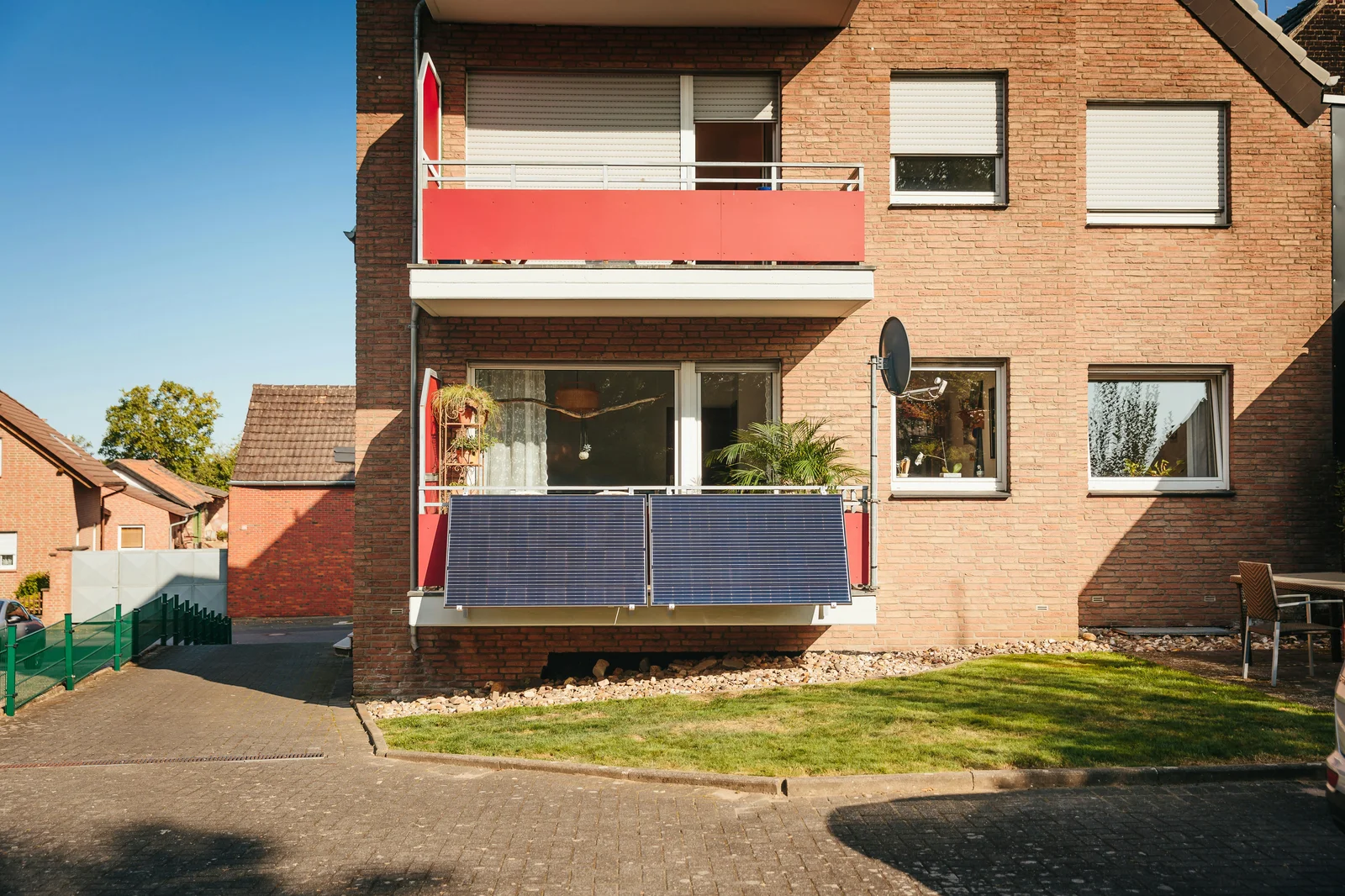
As of June 2025, over 1,009,390 balcony solar systems are officially registered in the German Federal Network Agency database.[10] More than 220,000 systems were added in the first half of 2025 alone. The German Solar Industry Association (BSW) estimates the actual operational number is two to three times higher due to unnotified legacy systems, delivering more than two gigawatts of decentralized generation.[1][10]
The German government adapted its regulatory system to match consumer demand:
- The 800W Standard: Germany finalized a dedicated DIN VDE electrical standard capping generation at 800 watts per residential meter.[1]
- Tenant Protections: In 2024, federal tenancy law was amended so landlords cannot reject a tenant’s balcony solar installation without demonstrating compelling architectural or safety harm.[10][11]
- No Net Metering Complexity: Balcony solar does not receive complex feed-in tariffs; excess generation spills back onto the grid without payment, keeping the registration paperwork down to a two-minute online form.[1]
As BSW Chief Executive Craig Morris observed during the policy transition: “If you get the law, then your work begins.”[1]
The United States has now entered that exact phase. The statutory barriers are falling; the manufacturing, hardware certification, and landlord standards are what remain to be built.
If Your State Hasn’t Passed a Bill
For readers in the forty-plus states without clear plug-in solar statutes, the path forward is legislative rather than commercial.
The National Caucus of Environmental Legislators (NCEL) and the World Resources Institute have published open model legislation that state lawmakers can adopt directly.[2][12] The policy framework relies on three pillars: defining plug-in generation under 1,200W as an appliance, exempting compliant devices from utility interconnection queues, and mandating NRTL safety certifications.
The eleven state bills that failed in 2026 will return to committee rosters in the 2027 legislative cycle. If you live in California, the Assembly Appropriations vote on S.B. 868 is happening this month.
The first full, system-level UL 3700 kits will arrive on US shelves in early 2027. The legal groundwork is being laid right now.
Find your state’s active bill number, locate your legislative representative, and send the model text. The technology is already proven; the grid is waiting on the code.
Sources
- IEEE Spectrum, “Plug In Balcony Solar Power Moves from Hack to Household” (July 21, 2026): https://spectrum.ieee.org/plug-in-solar-power
- World Resources Institute, “How States Can Unlock Affordable Plug-In Solar” (Feb 26, 2026): https://www.wri.org/insights/enabling-plug-in-solar-states
- Exact Solar, “Your State-By-State Plug-In Solar Update” (June 22, 2026): https://exactsolar.substack.com/p/your-state-by-state-plug-in-solar
- The Gadgeteer, “5 Balcony Solar Kits That Work in US Apartments Now” (May 18, 2026): https://the-gadgeteer.com/2026/05/18/5-balcony-solar-kits-that-work-in-us-apartments-now/
- Wattbuild, “Balcony solar in the US in 2026” (April 11, 2026): https://www.wattbuild.com/learn/about/477/balcony-solar
- MyOwnWatts, “Plug-In Solar: Everything You Need to Know (2026 Guide)” (March 16, 2026): https://myownwatts.com/blogs/solar-decoded/plug-in-solar-everything-you-need-to-know-2026-guide
- Bright Saver, Plug-In Solar Legislation Tracker (updated July 15, 2026): https://pluginsolarusa.com/
- PlugInSolarUS, “UL 3700 Explained” (March 25, 2026): https://pluginsolarus.com/learn/ul-3700-safety-standard-explained
- Solar.com, “2026 Guide to Balcony & Plug-In Solar” (Aug 12, 2026): https://www.solar.com/learn/guide-to-balcony-plug-in-solar/
- Reasons to be Cheerful, “The Game-Changing Potential of Balcony Solar” (Oct 27, 2025): https://reasonstobecheerful.world/balcony-solar-renewables-technology-game-changing/
- Canary Media/Grist, “How Germany outfitted half a million balconies with solar panels” (Sept 2024): https://www.canarymedia.com/articles/solar/how-germany-outfitted-half-a-million-balconies-with-solar-panels
- National Caucus of Environmental Legislators, “The Rise of Plug-In Solar” (March 13, 2026): https://ncelenviro.org/articles/the-rise-of-plug-in-solar-how-states-can-reduce-costs-and-streamline-clean-energy-adoption/
- pv magazine USA, “Ensuring safety of plug-in solar” (Aug 19, 2026): https://pv-magazine-usa.com/2026/08/19/ensuring-safety-of-plug-in-solar/